[Télécharger] Generative Adversarial Networks Cookbook: Over 100 recipes to build generative models using Python, TensorFlow, and Keras de Josh Kalin Livre eBook France
Télécharger Generative Adversarial Networks Cookbook: Over 100 recipes to build generative models using Python, TensorFlow, and Keras de Josh Kalin Francais PDF
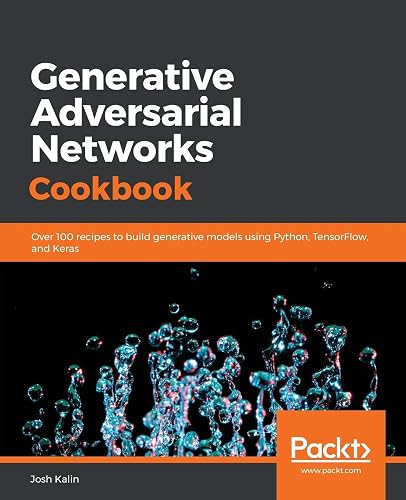
Télécharger "Generative Adversarial Networks Cookbook: Over 100 recipes to build generative models using Python, TensorFlow, and Keras" de Josh Kalin livre En ligne
Auteur : Josh Kalin
Catégorie : Livres anglais et étrangers,Computers & Internet,Software
Broché : * pages
Éditeur : *
Langue : Français, Anglais
Simplify next-generation deep learning by implementing powerful generative models using Python, TensorFlow and Keras Key Features Understand the common architecture of different types of GANs Train, optimize, and deploy GAN applications using TensorFlow and Keras Build generative models with real-world data sets, including 2D and 3D data Book Description Developing Generative Adversarial Networks (GANs) is a complex task, and it is often hard to find code that is easy to understand. This book leads you through eight different examples of modern GAN implementations, including CycleGAN, simGAN, DCGAN, and 2D image to 3D model generation. Each chapter contains useful recipes to build on a common architecture in Python, TensorFlow and Keras to explore increasingly difficult GAN architectures in an easy-to-read format. The book starts by covering the different types of GAN architecture to help you understand how the model works. This book also contains intuitive recipes to help you work with use cases involving DCGAN, Pix2Pix, and so on. To understand these complex applications, you will take different real-world data sets and put them to use. By the end of this book, you will be equipped to deal with the challenges and issues that you may face while working with GAN models, thanks to easy-to-follow code solutions that you can implement right away. What you will learn Structure a GAN architecture in pseudocode Understand the common architecture for each of the GAN models you will build Implement different GAN architectures in TensorFlow and Keras Use different datasets to enable neural network functionality in GAN models Combine different GAN models and learn how to fine-tune them Produce a model that can take 2D images and produce 3D models Develop a GAN to do style transfer with Pix2Pix Who this book is for This book is for data scientists, machine learning developers, and deep learning practitioners looking for a quick reference to tackle challenges and tasks in the GAN domain. Familiarity with machine learning concepts and working knowledge of Python programming language will help you get the most out of the book.Table of Contents What is a Generative Adversarial Network? Data First - How to prepare your dataset My First GAN in under 100 lines Dreaming new Kitchens using DCGAN Pix2Pix Image-to-Image Translation Style Transfering Your image using CycleGAN Use Simulated Images to Create Photo Realistic Eyeballs using simGAN From Image to 3D Models using GANs
Télécharger Generative Adversarial Networks Cookbook: Over 100 recipes to build generative models using Python, TensorFlow, and Keras de Josh Kalin Livres Pdf Epub
Generative Adversarial Networks Cookbook: Over 100 recipes ~ Generative Adversarial Networks Cookbook: Over 100 recipes to build generative models using Python, TensorFlow, and Keras / Josh Kalin / download / B–OK. Download books for free. Find books
9 Books on Generative Adversarial Networks (GANs) ~ Title: Generative Adversarial Networks Cookbook: Over 100 recipes to build generative models using Python, TensorFlow, and Keras. . Title: Hands-On Generative Adversarial Networks with Keras: Your guide to implementing next-generation generative adversarial networks. Written by Rafael Valle, published in 2019. This may be one of the better Packt published books as the code appears to be .
GitHub - bstriner/keras-adversarial: Keras Generative ~ Keras Adversarial Models. Combine multiple models into a single Keras model. GANs made easy! AdversarialModel simulates multi-player games. A single call to model.fit takes targets for each player and updates all of the players. Use AdversarialOptimizer for complete control of whether updates are simultaneous, alternating, or something else entirely. No more fooling with Trainable either!
Generative Adversarial Network(GAN) using Keras / by Renu ~ Generative Adversarial Network(GAN) using Keras . Renu Khandelwal. Follow. Feb 9, 2019 · 6 min read. In this post we will use GAN, a network of Generator and Discriminator to generate images for .
Deep Convolutional Generative Adversarial Network - TensorFlow ~ Generative Adversarial Networks (GANs) are one of the most interesting ideas in computer science today. Two models are trained simultaneously by an adversarial process. A generator ("the artist") learns to create images that look real, while a discriminator ("the art critic") learns to tell real images apart from fakes. During training, the generator progressively becomes better at creating .
Generative Adversarial Networks for beginners – O’Reilly ~ Generative adversarial networks consist of two models: a generative model and a discriminative model. The discriminator model is a classifier that determines whether a given image looks like a real image from the dataset or like an artificially created image. This is basically a binary classifier that will take the form of a normal .
Building a simple Generative Adversarial Network using ~ Building a simple Generative Adversarial Network (GAN) using TensorFlow. Generative Adversarial Networks or GANs are one of the most active areas in deep learning research and development due to their incredible ability to generate synthetic results. In this blog, we will build out the basic intuition of GANs through a concrete example.
GAN by Example using Keras on Tensorflow Backend / by ~ Generative Adversarial Networks (GAN) is one of the most promising recent developments in Deep Learning. GAN, introduced by Ian Goodfellow in 2014, attacks the problem of unsupervised learning by training two deep networks, called Generator and Discriminator, that compete and cooperate with each other.In the course of training, both networks eventually learn how to perform their tasks.
Simulation Optimization / Add AI to Simulation Models ~ Pathmind helps businesses find better ways to save money and increase output by using AI for simulation optimization, and then deploying trained AI into operations. Our web application frees up your time and local resources while it searches for solutions using reinforcement learning and cloud computing clusters. Once the best decision paths have been found, Pathmind creates an AI policy to .
Building Autoencoders in Keras - The Keras Blog ~ Let's train this model for 100 epochs (with the added regularization the model is less likely to overfit and can be trained longer). The models ends with a train loss of 0.11 and test loss of 0.10.The difference between the two is mostly due to the regularization term being added to the loss during training (worth about 0.01).
Image Generation in 10 Minutes with Generative Adversarial ~ As you can see in Figure 11, the outputs generated by our GAN becomes much more realistic over time. Congratulations. You have built and trained a generative adversarial network (GAN) model, which can successfully create handwritten digits. There are obviously some samples that are not very clear, but only for 60 epochs trained on only 60,000 .
Inside the Generative Adversarial Networks (GAN ~ Generative Adversarial Networks (GANs), represent a shift in architecture design for deep neural networks. There are several advantages to using this architecture: it generalizes with limited data…
GitHub - xinntao/ESRGAN: ECCV18 Workshops - Enhanced SRGAN ~ Enhanced Super-Resolution Generative Adversarial Networks. By Xintao Wang, Ke Yu, Shixiang Wu, Jinjin Gu, Yihao Liu, Chao Dong, Yu Qiao, Chen Change Loy. We won the first place in PIRM2018-SR competition (region 3) and got the best perceptual index. The paper is accepted to ECCV2018 PIRM Workshop. 🚩 Add Frequently Asked Questions. For instance, How to reproduce your results in the PIRM18-SR .
Keras: the Python deep learning API ~ Iterate at the speed of thought. Keras is the most used deep learning framework among top-5 winning teams on Kaggle.Because Keras makes it easier to run new experiments, it empowers you to try more ideas than your competition, faster.
TensorFlow ~ TensorFlow is an end-to-end open source platform for machine learning. It has a comprehensive, flexible ecosystem of tools, libraries and community resources that lets researchers push the state-of-the-art in ML and developers easily build and deploy ML powered applications.
pandas - Python Data Analysis Library ~ pandas is a fast, powerful, flexible and easy to use open source data analysis and manipulation tool, built on top of the Python programming language. Install pandas now! Getting started. Install pandas; Getting started; Documentation. User guide; API reference; Contributing to pandas; Release notes; Community. About pandas; Ask a question ; Ecosystem; With the support of: The full list of .
Advanced Python Tutorials – Real Python ~ Advanced Python Tutorials. In this section you’ll find Python tutorials that teach you advanced concepts so you can be on your way to become a master of the Python programming language. Once you’re past the intermediate-level you can start digging into these tutorials that will teach you advanced Python concepts and patterns.
Java Deep Learning Cookbook - Train neural networks for ~ In addition to this, you'll learn to import models from Keras and change the configuration in a pre-trained DL4J model. Finally, you'll explore benchmarking in DL4J and optimize neural networks for optimal results. By the end of this book, you'll have a clear understanding of how you can use Deeplearning4j to build robust deep learning applications in Java.
TensorFlow: Advanced Techniques / Coursera ~ Offered by DeepLearning.AI. About TensorFlow TensorFlow is an end-to-end open-source platform for machine learning. It has a comprehensive, flexible ecosystem of tools, libraries, and community resources that lets researchers push the state-of-the-art in ML, and developers easily build and deploy ML-powered applications. TensorFlow is commonly used for machine learning applications such as .
Generative Adversarial Networks (GANs) / Coursera ~ Offered by DeepLearning.AI. About GANs Generative Adversarial Networks (GANs) are powerful machine learning models capable of generating realistic image, video, and voice outputs. Rooted in game theory, GANs have wide-spread application: from improving cybersecurity by fighting against adversarial attacks and anonymizing data to preserve privacy to generating state-of-the-art images .
PyImageSearch - You can master Computer Vision, Deep ~ In this tutorial you will learn how to implement and train siamese networks using Keras, TensorFlow, and Deep Learning. This tutorial is part two in our three-part series on the fundamentals of siamese networks: Part #1: Building image pairs for… Building image pairs for siamese networks with Python. November 23, 2020. In this tutorial you will learn how to build image pairs for training .
DCGAN Tutorial — PyTorch Tutorials 1.7.1 documentation ~ We will train a generative adversarial network (GAN) to generate new celebrities after showing it pictures of many real celebrities. Most of the code here is from the dcgan implementation in pytorch/examples, and this document will give a thorough explanation of the implementation and shed light on how and why this model works. But don’t .
What is Machine Learning? Machine Learning Courses ~ Deep Learning is a superpower.With it you can make a computer see, synthesize novel art, translate languages, render a medical diagnosis, or build pieces of a car that can drive itself.If that isn’t a superpower, I don’t know what is. — Andrew Ng, Founder of deeplearning.ai and Coursera Deep Learning Specialization, Course 5
Deep Learning Cookbook: Practical Recipes to Get Started ~ Python -- Python 3 is preferred, but Python 2.7 should also work. We use a variety of helper libraries that all can easily be installed using pip. The code is generally straightforward so even a relative novice should be able to follow the action. Keras -- The heavy lifting for machine learning is done almost completely by Keras. Keras is an .
Comments
Post a Comment